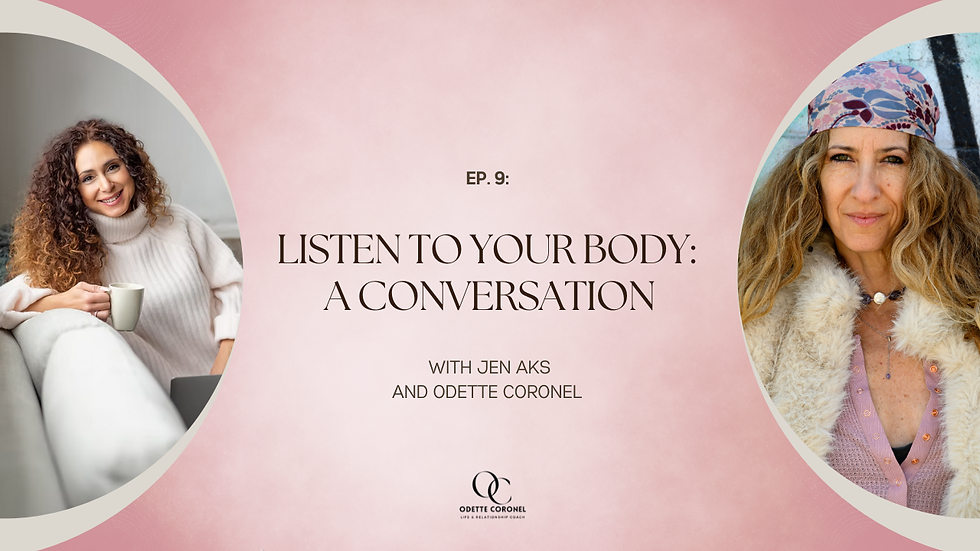
EP. 9: Listen to Your Body: A Conversation with Jen Aks
Updated: Dec 2, 2025
Sometimes we have to get to rock bottom before we make a change. My life coaching clients will sometimes come to me, telling me about the worst ways they’ve ever treated themselves, and they feel so incredibly guilty about it. They feel guilty because they didn’t trust themselves to make the right decision, and they don’t know how to find that worthiness in themselves again. Today, we’re going to work on how to listen to your body and restore that sense of self-worth, together, with a little help from this week’s guest.
Jen Aks, is an embodiment coach, author, thought leader, and founder of The Power of Gesture®, a groundbreaking bodyset practice that has helped thousands of women since its 2020 inception. While mindset helps us shape what we think, bodyset connects us to what we feel—offering a direct path to authenticity, presence, and confidence.
In this week’s episode, we’re talking about how to listen to your body and get back to who you truly are. Jen Aks argues that we are not broken, and this practice of listening to our body is not about fixing ourselves, but restoring what is already within us. By listening to our bodies, we can start to heal the worthiness wound that we’ve been ignoring for too long. Tune in to Jen’s episode to hear all about her rock bottom moment and how she’s been restoring her self-worth for herself and for her coaching clients.
Follow Jen on:
Follow Odette on:
Website:www.odettecoronel.com
How to work with Odette:
Transcript: EP. 9: Listen to Your Body: A Conversation with Jen Aks
Odette: [00:02:00] Welcome back to Life and Love by Design. I'm your host, Odette Cornell, and today I'm really excited to be joined by Jen Ax. Jen is an embodiment coach. She's an author, she's a TED Talk speaker, and she's all about embodiment, authenticity, presence, and connection. So welcome Jen. Thank you so much for joining me here today.
Thank you for having me. Yes, of course. So I'm gonna have, I'm gonna ask you to tell us a little bit more about yourself, but before you do, I like to kind of start with something light and something fun. Yeah. So I just wanna ask you, thinking back on this past week, what is something that has made you laugh or maybe surprised you?
Jen: Ooh. Well, you know, it's funny because it's like starting with something light. Well, there is a lot of light in what I'm about to say. So my father passed away this [00:03:00] week. That's not light. Okay. Oh, I'm so sorry. But there is lightness and I say that because what's surprised me? Was how much light and beauty came out of this week.
the deep connections in my, family and there's been a lot of laughter and joy and memory. And so this week has been really kind of interesting, uh, when I reflect on it at how much laughter has come from just sort of reminiscing about, you know, my life with my brothers and. You know, just life, you know that.
I'm sorry. You were like, goodness. Start by.
Odette: I was not. That's what happened this week. Not expecting that. Okay. No, and uh, I am, first of all, I am so sorry for your loss. You know my condolences. No, it's okay. To you and your family. Thank you. Thank you and, um, thank you. I was not expecting that, but I, I know, I know what you mean in terms of when we get together with family and Yes.
In a moment of, of pain and loss and it's really an opportunity. It's, it's beautiful in a sense [00:04:00] that it brings a family together and it's an opportunity Absolutely. To reminisce and remember our loved ones, you know? Yeah. And, and laugh and cry together. And it's absolutely. It, it is beautiful. So, again, my condolences love, I'm sending you up.
No, it's okay.
Jen: It's okay. Because the things that you mentioned, you know, you said laughter and also surprising and that's really what showed up is like the surprise joy that really came from this moment. And I, I love that and I appreciate all of it. So. That's what was on my heart when you said that.
Odette: Well, thank you for sharing with us.
Thank you for sharing. Very special. Yes. So now tell us a little bit more, I briefly kind of gave the highlights on who you are and what you do. So I'm gonna let you tell us more about you and what you do.
Jen: Oh, thank you so much. so yes, it's all about leadership. Coaching really is the focus, but embodied leadership coaching, which is all about.
It's really all about leading from the inside out. And when I say leadership, I'm not talking [00:05:00] about just, you know, corporate leadership. I'm talking about anyone influencing another human parents, leading children, you know, CEOs leading businesses, or managers leading teams, or ourselves leading ourselves in our relationships.
Whatever they are, our relationship with ourself, it's that authenticity. It's really empowering people to know that there's so much wisdom within themselves to access and rely on, to have empowered and impactful leadership in their life. And that's what I do is really awaken that for people.
Odette: I love that.
I love that. Yeah. And leadership people, we normally think about corporate leaders or having these huge businesses, but really we're all leaders in some way. We're all influencing whether it's our, our loved ones, our family, or in our, our career and our clients. Absolutely. Um, so you, in your TED Talk, and even in your book, you make that connection with.
[00:06:00] The body and finding the wisdom within. So it's not just about mindset work, but about really connecting both the mind and the body, which I absolutely, yeah, I absolutely love that. How, how, what was your journey like? you know, this show or this podcast is all about living and loving by design, so right intentionally.
How did you create this life that you have now? What was your journey in your transition? I know that you were, that you're a dancer mm-hmm. And you were a teacher and all of that. So what, what has your journey been like?
Jen: Yeah, I really appreciate the question because it is the answer to what it is that I'm doing and how I've designed my life to, to make the impact that I am and hope to continue making.
So, you know, it starts really. In the classroom for me, when I was younger, I was, I became very disembodied from my truth, from my knowing, from the intelligence within my wor my sense of [00:07:00] worthiness, really, because I measured my intelligence and my worthiness up against what society was defining as smart.
When I was in high school, it was all about SAT scores and IQ scores. Everything was about these traditional. Tests and your intelligence was measured by that. So I was like, okay, well then I guess I'm not smart because I didn't do well on any of it. Yeah. And so I really did develop this story, which disconnected me from my body and my truth, and I carried that story for almost two decades, and it was debilitating.
Honestly. There were so many experiences that I didn't. Enter into opportunities that were in front of me, and I just felt like I wasn't smart enough to take them. So I didn't. And then when I was about 28 years old, I had my rock bottom moment where I was. Asked to go to dinner with John F. Kennedy, Jr. The former president thought.
Yes, I know. Oh my goodness. [00:08:00] Wow. And I was, I know. I wanna hear the story. Yeah. Okay. I'm gonna tell you'll later, later, later. Well, well, I'll sum up that I was invited with my boyfriend at the time, and it was the four of us. It was JFK, Junior's wife, Carolyn Bissette Kennedy, me and my boyfriend. Okay, so I, yeah.
How I came to that is a whole other story, but I basically, when I got the invitation, I froze and I just crumbled completely. I did not go because I didn't think that I was smart enough to be at that table. Right? And that's a big moment, right? Jonathan Kennedy, Jr. So I complete, that was my bottom, and I just thought that night, I was so disappointed in myself and so upset that I allowed.
You know, society to hijack my worthiness and I was done. So I made a real commitment to myself that night that things were gonna change. So I found the work of Howard Gardner and this was really the shift that helped me start to [00:09:00] like reembody and find my truth and gain my confidence and my life. Right, right.
The way I knew that I should and could. So I found this body of work, which is all about multiple forms of intelligences and. Two of which. we all have innately kinesthetic intelligence and emotional intelligence, and I can go into that, but the bottom line is these are innate intelligences within us, and I always connected to both of those.
Kinesthetic being the physical body's ability to like learn and process and communicate with our body. With movement and emotional intelligence is our ability to connect to our emotions and understand them and use them to lead our life and really allow ourselves to tap into that intuition and trust it.
So both of these were very familiar to me 'cause I was a dancer my whole life and I was very connected to my body and it kept me kind of in a little bit of confidence and worthiness. But I didn't understand what all that meant until this research. And I was like, oh, [00:10:00] these are my two forms of intelligence and everything changed after that.
And we can talk about all that. But that was the shift. Okay. And then I wound up doing other. Work efforts that really focused on kinesthetic and emotional intelligence, including the body and dance. And many years later, I'm now doing what I'm doing to really unlock this for people because there is a real connection there.
Odette: Right? Yeah. Yeah. And even, um, with the, which remind me about the Kennedy store. So I do wanna go back to that. Yes. But that, that's interesting how, you know, you find, you read one thing or you find one thing and it kind of. Everything kind of makes sense. And you, you were able to put together that emotional intelligence piece with the kinesthetic learning and Yeah.
Yeah. I, I know, I, I actually homeschooled my kids for part of their education and it, it's, part of it is because of what you were saying before school. The traditional schools sometimes measures intelligence in one way only, and everything is very cookie cutter and it [00:11:00] leads some people to feeling.
They're just as intelligent, just in different ways, and it doesn't really Right. Help you honor that. So to be able to find your style of learning is, is wonderful because then you can truly blossom. Absolutely. In whatever way, you know, makes sense for you. And with the kinesthetic. I remember even in, you know, with the kids when we're teaching something, one of my children in particular is more, I would say, kinesthetic and we're learning how to read and basic things.
But I would have them moving, doing something like standing up or, or doing some kind of movement while we were learning and that helped them. Learn and process better. So that totally, absolutely, totally makes sense. Totally makes sense. You know,
Jen: I wanna just quickly add it. Everything you're saying is exactly right and the very interesting and ironic, and I actually don't even think it's a coincidence or ironic, I think it's divine intervention.
When I found all of this research and it goes very deep and I did a lot of work on it. [00:12:00] I then found an organization that I aligned with that taught children K through 12, curriculum through the arts. So I was teaching actual curriculum through the body, with poetry, with music, with dance, and I poured my heart and soul into this organization for almost, you know, 18 years.
And I wound up teaching the teachers and training hundreds of children. So it became like this healing journey for me because it validated everything that I needed and everything I came to learn. And it also became a very empowering journey for me because it led me to the work that I'm doing now. So it's just very interesting.
Yeah. And I'm so glad to hear you taught your kids Yeah. In this way. 'cause I understand that 'cause I did it, you know, with a lot of children. Yeah.
Odette: Yeah. That, that's beautiful. And through dance you mean. Especially for people that sometimes we're not able to express ourselves verbally or, or articulate what we wanna say or what we're [00:13:00] feeling.
And to be able to do it with our bodies or dance or, or any kind of creative form is so important. but I wanna get into that body set work.
Jen: Yeah. That, that, that piece
Odette: that you're talking about. back to first your TED Talks. I know that you, you now have this book. What is it that you wanted people to remember or feel specifically just from what the information that you were sharing, what is that one message that if they could just remember that one thing, what, what did you wanna communicate to them?
Jen: Yeah. That their body holds intelligence that is meant for them to rely on. For truth so that they can lead their life authentically and powerfully. It comes from within. That is the main, I wanna arm people with this message that they have the wisdom, they have the answers within themselves. And so that's the overarching what I want them to walk away with.
And [00:14:00] you were mentioning body set. So the messaging underneath the umbrella takeaway is that we have been trained and conditioned to think our way through life so often, and the thinking brain is obviously so incredibly important and we need that logical mindset. But the, the asset inside of ourselves that we don't pay nearly enough attention to is body set because the body.
Is the physical and emotional state that informs the mindset the body knows before our mind does. Yeah, and there's a lot of science about this and a lot of research around this as well, and I talk about a lot of that in my book. So people rewiring and reconditioning and awakening to this understanding that their body holds wisdom and to remember that our ancestors, right, the hunters and gatherers.
They survived and thrived on [00:15:00] instinct. They knew how to protect, they knew how to feed, they knew how to do all the things. But technology has, has created this divide. We need the technology, but we cannot lose the emotional intelligence because technology and AI can never replace that. Right. So that's really like the urgency right now is coming back to this innate wisdom because we need to partner.
With where the world is going, especially with ai.
Odette: Right? Right. Yeah. We need to adapt, but we wanna make sure that we hold onto our humanness and exactly when we feel that gut instinct that is our body giving us some kind of message, or even, I would say, even our emotions and we feel anxious. You know, you feel it in your body, you feel it in your stomach maybe, or your shoulders tense up and you wanna listen to it.
And, um, absolutely. That makes so much sense. It makes so much sense. We need to listen to it. Yeah, yeah,
Jen: yeah. Because right. If we, if we have that angst in our belly for whatever reason, or our heart starts [00:16:00] racing, our head starts pounding instead of, I wish I didn't feel this way. And trying to push it aside, really leaning in my thing is we body set at that exact moment.
As soon as that angst hits your body. Body set hand on your heart and your stomach, and close your eyes and welcome it and not be afraid of it. Yes, I'm doing it now. Yeah. Yes. It feels good. Yeah. Right? Mm-hmm. It feels good. Hand, heart, stomach, closing your eyes. And this is the body set position in my practice.
It's just like runners. When they're in that get ready position, that's what we do. And allowing the angst, the worry, the fear to be heard. And then learn about it and lead from that place. 'cause when we try and push it aside and get rid of it just gets louder.
Odette: Yeah. Yeah. We don't wanna repress it. We wanna pay attention to it.
Right. I love it. Right. It makes, makes so much sense. What about there are lots of people I have, I have, I work with clients and, you know, they're successful maybe in, [00:17:00] in their career. They seem to have checked off all the boxes. They're doing everything that they're supposed to be doing, and yet mm-hmm.
They're completely disconnected from their bodies. Or I even, I even have, um, women that I work with who actually, not only are they disconnected from their bodies, but they have a negative. Relationship with their bodies. Almost like a, like a self-loathing, you know, in an extreme way, but where they just really don't even.
Want to connect with their bodies or they're just so disconnected they don't know how to listen to themselves. What would you tell someone like that? How can they learn to kind of reconnect with themselves? Because I'm sure when they were children and at some point when they weren't so much in their heads, they were connected to their bodies and they were able to dance and run and play and do all of those things.
So how do they learn to reconnect with themselves and their bodies?
Jen: Yeah, so the first thing I feel is the, the story we tell [00:18:00] ourselves and the narrative that we follow. If we can shift the perspective and say, okay, when I was a child, I did have that freedom in my body when I was a child. I did have that joy and that play, and I wanna get back to that.
If we can look at that and say, this is an opportunity to get back, instead of, I, I can't connect to my body. I don't know how to do this. It's, yes, you do. Understanding you once had it and it is our journey and this is an opportunity to return back to that. So how do we return to that? In my work, I would tell someone and guide someone to body set right hand on heart and stomach and closing the eyes and using the mind, the imagination to remember and recall.
On a memory where there was joy, where there was confidence. It could be from childhood or it could have been a week ago, and we're just like feeling out of sorts right now. But a week ago we did this great presentation, we felt amazing, or whatever the memory is, however far back it goes, [00:19:00] really channeling a memory that brings that joy in that light and that happiness and allowing your body to fill up.
On that feeling because when we can bring in that energy, we're making an imprint on the body and we're creating a memory. So like the idea is to, you know, shift out of that. I, I'm terrible, I can't do this. I don't have, I'm not connected to, to just a joyful, like shifting the vibration. So I would start with, the understanding that.
We are capable and wise, and this is about returning and restoring. This is not about fixing. That's the other thing is people have this disconnection from themselves because they think they're broken and they need to be fixed. Right? And this is not about that at all. This is about restoring what's already within ourselves.
It's just been lost. [00:20:00] So that conversation of the returning is important. And then that reframing of, okay, this is an opportunity. I know it's within me. So body set, call on a memory, fill yourself up with the energy. And then my practice specifically is about the embodiment, you know, using the gestures. To, to enhance the feeling that we're remembering.
Is this making sense? Yes, absolutely. Absolutely. Yeah. So, okay.
Odette: Setting yourself like the body set. Body set. Yep. And remembering
Jen: That's right. Remembering using
Odette: the imagination and remembering when you did feel it, because it That's right. It is within you.
[00:21:00]
Jen: It is within you. Right.
Odette: and reframing the stories that we tell ourselves, I think Makes sense. It's a huge part. 'cause we just believe that this is just who we are and we Exactly. We, we, we won't sometimes be open to even the idea that it's possible. So kind of just shifting that story also, I think is a huge part of it.
Jen: Absolutely. And the, the biggest piece in the work that I do is about the, the body set practice that I've created is called the power of gesture. Mm-hmm. So what we just talked about. The grounding, right. Body set [00:22:00] imagination, feeling it. And the T for gift, because that's how I look at this. It's a grounding imagination feel, right?
If we're looking at the steps. Mm-hmm. And the transforming, which is t. Is that body set. And so using like we call on a feeling, so the joy, let's say that we remember when we're running around as a child in the playground, where do you feel it in your body? And then create a hand gesture that actually embodies the emotion.
So what people will feel is a transformation because they went from, oh, I'm not connected to my body and I'm not really feeling good about myself to body set. Imagine the, the. Moment, the memory, feel it, and then transform that energy into,
Odette: so is everyone's gesture gonna look different or do you kind of Absolutely offer them a gesture to try?
Jen: Yeah, so it's really interesting. I've, at this point, because this started in COVID. Because I, we were in the screen, right? Mm-hmm. [00:23:00] We were in a Zoom screen like this, zoom, and I was using all the stuff that I came to the research and the understanding of the body's wisdom and everything, and I didn't want people to get up and do big dances.
I needed them to stay in the screen, so I asked them to embody their emotions with the gesture and magic was happening, and so much transformation, and now it's become the power of gesture. I say all of that because I've worked with so many people from all over the world because this started. On Zoom, and we were all, all over the place, right?
And never had anything better to do. So people were seeing me. So the gestures that I have seen are so uniquely different. Everybody, different cultures, different sizes, different shapes, backgrounds, religions, like I've seen it all, and it's incredible. Like someone's fear might look like this with fists together and shaking someone else's fear might be like a slapping on their arm or like a, you know.
like a total inner contraction, like withdrawal,
Odette: yeah. Mm-hmm.
Jen: Oh, withdrawal, right? Mm-hmm. And [00:24:00] someone else's ge, you know, so everyone's gestures different, but I will say what I have learned by working with so many different types of people is that when we feel confident and worthy, our gestures are expansive.
We open up, and when we feel doubtful, worried, insecure, ashamed, the gestures tend to contract. Right. That is the universal understanding of all gestures. Totally. D Oh yeah. Like the superman
Odette: pose that they
Jen: for confidence and Yeah. Right. That makes sense. Yeah, exactly. Mm-hmm. So I hope that answered your question.
They all look different, right? But that's sort of the universal understanding is that the contraction is connected to the limiting belief and the expansive gestures are connected to more empowering beliefs.
Odette: Right. Okay. Okay. And then you're able to shift from the limiting belief to the other side of it, just with the use of gestures and whatever comes out.
Jen: Yeah, whatever comes out. Absolutely. I mean, if you did this with me right now and you put your hands here together and you just [00:25:00] like allowed them to really be tense and shake even. Mm-hmm. Mm-hmm. And then slow it down so it's calm and then open your fingers very slowly. Opening. Opening and really releasing and go as far as you feel like you can, people Yeah.
Can go all the, mm-hmm. Right. So you are transforming that energy from this limitation and contraction to an expansion.
Odette: Yeah. And this feels like uncomfortable almost. It feels restricting, whereas this feels expansive. Yeah. And empowering.
Jen: Yeah. Absolutely. Absolutely.
Odette: Mm-hmm. I love that. What is a, a story from your book of someone, where this, that has implemented some of these gestures or some of these, you know, physical, you know, mindsets, some the body set work and has really.
Been impacted just in their lives or been able to make a transformation, just something that they [00:26:00] notice about themselves by doing these things they noticed, or by going into their body and listening to the wisdom of their body, they were able to, something positive came out of it. Just, just like kind of like a, an example.
Jen: Yeah. So I talk about a few clients of mine in my book alongside some of my stories as well. One of my clients that's coming to me is she, she came to me because her body felt so shut down because she came from a very religious background, and it was like shamed on to experience love and joy in this expansive way in her religion.
It wasn't until later in the afterlife that you experienced that level of joy. Interesting. Yeah. Right. So her internal. She had this instinct like, I wanna be joyful. Why can't I be joyful? I feel like I'm gonna have so much more abundance in my life. Yet this restriction was just completely holding her back and it actually had to be [00:27:00] hidden.
You know? She really had to hide the fact that she was working with me, because if anybody found out for her, it would've been a lot of trouble. So through the work that we did, we really had to do a lot of unpacking and. I tend to look at each emotion inside of us as a child that just needs to be heard.
And in her case, she had several children that really were like kind of screaming this like anger, right? Mm-hmm. She wanted joy so badly, but she was angry and she was resentful and she was worried and she was scared. So we did a lot of work around each emotion in a singular, in a singular way. Giving each child each emotion an opportunity to speak.
So we gave each one a gesture that came from her. I guided her into really listening to each part of her. Yes, each emotion. Mm-hmm. And then again, body set. She uses her [00:28:00] imagination to really see that emotion, that anger. As one singular child. What is it you're trying to teach me? Talk to me about your anger.
You know, really focusing. Then from there she imagined she felt she transformed, she created the gesture. So what I found with this particular client is that by giving each emotion really, truly an opportunity, almost like the stage to just speak and scream, we put, I always use music. Music is a big part of my practice and for her.
The gestures became a full-bodied experience, and especially with like the anger piece she, we put on music, she got up, she started kicking and scream and her. Mm-hmm. And by allowing these voices to be heard with the, and expressed with the gesture they released, the voices turned down. And all of a sudden on the other side of that, it was like she broke [00:29:00] free of this and found her joy.
And the, the beautiful thing was when I saw her break free, especially the anger, break through the anger, and then SA smile was kind of coming on her face so you could see and feel the joy in her gestures in her body. It was so emotional and I realized, you know, they just wanna be heard,
Odette: right? These
Jen: parts of ourselves just wanna be heard, and on the others, when we give them the opportunity.
They expand, they break free. Right? They can fly.
Odette: Yeah. They become unburdened. Really? Because they're just trying to protect her. Right. And once they're, you can listen to them and they're heard. It's almost like they're set free.
Jen: Yeah. And then the thing is, is that there's all of that emotional healing, but all of that is wisdom.
Mm-hmm. All of that is intelligence. Right. That is in her case, is meant to serve her and empower her and help her write that book that she was starting to write and help her lead. Her life and her children and live by [00:30:00] design, right? She had to move through all of that and then just knock, not just walk away saying, okay, I feel better.
But really as the leader in her life, to use that as wisdom and intelligence to inform who she's becoming,
Odette: right. Yeah. That's beautiful. That's beautiful. That's, that's an example, beautiful example of the transformation and then how she Right. Applied it in her life, brought herself joy. Right. And I'm sure that that positively impacted not just her, but her family and, and maybe she was an example to the other.
Generations or other family members who yes, were feeling the same way and were ashamed for wanting to feel joy and happiness, and maybe she absolutely in some ways broke, Barriers. Barriers. Yeah. Barriers. Exactly. Yeah. Exactly. Yeah. She's an example in her own life.
I love that. Beautiful. Well, you know,
Jen: it's, it's so, you're so exactly right. She came back after this particular session. She came back to the next one. I'll never forget, she said, you know, my [00:31:00] friends are asking me what am I doing? What did you
Odette: do?
Jen: Yeah. Because you look good girl like you look, and she, you know, so there's a lot of power in what you just said.
It's very true. She became an example. For other people.
Odette: Right, right. I love that. What about, so, you know,I'm primarily a relationship coach, so I work with individuals and I work with couples. What would you say for couples or people in a relationship where maybe they're kind of out of sync and maybe one person is connected to their bodies and the wisdom within, but the other partner is maybe a little bit more disconnected from themselves?
Is there anything that you can, can think about or recommend for someone to be able to maybe help their partner reconnect with themselves a little bit? Is, is that something, and is there any re relational way to kind of implement this body set work?
Jen: Yeah, absolutely. I mean, what's coming to me right now is that I think there's a [00:32:00] lot of people that are like, oh, is that, that's so woo woo.
They're like sort of the naysayers of mm-hmm. This kind of intelligence again, because we haven't been taught how to listen to our bodies and we haven't been taught that it's a real. Reliable source of intelligence. Yeah. So I think,
Odette: or we wait, many people wait until there's an illness or they're feeling sick.
Right. And then they'll finally listen and do, you know, make changes in their bodies, but we shouldn't wait Absolutely. To get sick to listen to our bodies.
Jen: That's right. That's right. Mm-hmm. Absolutely. So if I was working with a couple that, and one was really embodied and connected and one was not.
What I would do is I would actually present some information around the research behind Body Set. And emotional intelligence and the power of it and why it's so necessary and why it's a real thing and so to almost, because some people that may not [00:33:00] get it and are disconnected might be more logical thinkers and they need to learn how to.
Tap into the body. So I would definitely do a body set practice around connecting to the truth and how we feel. So for example, if someone said, you know, this is how I'm feeling, and they're not getting it, and they're just completely disconnected, have both people body set and really tap into what it is that person is feeling and connect through that way.
Also, combining that with. Presenting some of the research, because some people need to see that. They also need to understand the science behind the hands and the brain and the connection and how the embodiment can unlock this wisdom. Mm-hmm. So everyone's got a different way in, but I would start with the body set practice, and if that didn't work, then I'd come in with a lot of the research and the science
Odette: behind that.
Right. Here's the research, it's gonna work. You just have to try. Exactly. Then they'll believe it, then they'll believe it, and then they'll try it.
Jen: Yeah. Yeah. there's so much [00:34:00] around, you know, putting the value into our emotions and really teaching people and helping people understand the value of that, honoring that, and what that practice really looks like.
A lot of people just don't know how to do that, and they need to be taught.
Odette: Yeah. Which
Jen: is okay. Right.
Odette: And, and, and some people don't even connect their emotions Yeah. With the body. And that this is just an emotion that's trying to get your attention. It's trying to show, tell you something through your body, through either physical pain or maybe some, or maybe a positive feeling.
But the point is, I think to really be in tune with. Our bodies to go within, whether that's meditation or being in nature or dance or movement. I think dance is so spiritual. I love that you're a dancer. Maybe you could talk a little bit more about, about that too, how that's connected to the wisdom, just through movement and dance.
'cause for me, dance is, it's also almost like you're in a trance. Right? I love dancing as well, and it's like it's spiritual in a way.
Jen: [00:35:00] Absolutely. Can you talk a little bit about
Odette: dance and that connection?
Jen: Yeah, absolutely. I mean, I talked about this in my TEDx and I actually danced on stage. I You saw it, right?
I did. I saw that. I was like, I love that. That's great. Right? So, but that's where this awakening of the body and movement and dance and kinesthetic intelligence is a real thing. I used to go to the, I mean I still do, but I used to go to the clubs all the time and I love to go out dancing New York City and I always.
Yeah. In near in New York City. Yeah.
Odette: Did you go to
Jen: the Limelight? Yes,
Odette: I totally did. Did you? You know what, I was not a big club person, but all my friends would go to the Limelight. I'm more of a house party girl, and my, my husband used to dj, he still DJs all of our house parties and we would throw great parties.
Okay. I love that. But all of my friends were going to the Limelight and all, all the clubs in New York. Yeah. So, yeah. Well,
Jen: I don't like that. I don't love the, like, UNO, UNO, you know that like hard Yeah. I right. I like more of like a, a seventies [00:36:00] hip hop old school. Mm. Yeah. But anyhow, so I would go to these places and really, really get lost in the movement, lost in my moment.
But I oftentimes would look up and I would really connect to the people around me or the person directly in front of me, and we would continue to dance. And it was almost like we were having a conversation without saying a word, and I knew. That that was a very powerful connection and that showed up in a lot of different ways in my life as a performer on stage, being able to communicate with the audience without saying a word, knowing that it's a storytelling expressive modality to be able to dance and share and exchange in this way.
And when I did the research and found out about so much regarding kinesthetic and emotional intelligence, that all made sense to me. So dance is a very powerful form of sharing and expressing and [00:37:00] understanding each other and ourselves. And it's not just dance like I've broken it way down and dialed it way down to just use the hand, just use the hands.
'cause it's really, again, just using the body. And as a dancer, I just know the power of it. So it kind of led me here. Right. I was gonna just comment on one thing I think you said before, that. You know, it is. It is so important that when we find that joy or the connection to the wisdom inside, whether we honor the pain, the angst, the worry, whatever it is we're doing to process, we can stop there just like we do maybe in meditation or yoga or if we're dancing.
But I take it that step further and I think it's really important to take what we've learned and use it to inform. Our decisions with our children, with our friendships, with our relationships, with designing, you know, curriculum for classes or [00:38:00] designing an agenda for our team at work that it is actually telling us.
What our authentic passion is and what it is we wanna bring out into the world. And so like using all of that emotional intelligence for good, for service.
Odette: Right, right.
Jen: If that makes any sense.
Odette: Yeah. Yeah. Right. I love it. Yeah. It's not just the insight, but then what can I do with this? What do you do with it?
What do you do with it? And you could do, so if you listen to it, you're gonna be guided to do something amazing. To do what you're meant to do. Right. You're gonna live, you know what I call it is with intention and purpose. Right. Not just with default by default, but you have to listen to it.
Jen: Right?
Odette: Exactly.
Yeah, exactly. I love that. Mm-hmm. I love that. So, um, so I've got three kids. My kids are, are big already. but I see so much of this younger generation. They're very sedentary. They don't, they're, you know, they're either playing video games or they've got their headphones on and they're in virtual worlds and, you know, I'm not, you know, kind of mad [00:39:00] badmouthing the younger generation, they're wonderful, right?
But, but. I feel like there's a little bit more of a disconnect in general. I'm generalizing they're a little bit more disconnected just because they're, they're just more sed sedentary than we were, I believe. Yeah,
Jen: yeah.
Odette: What do you say to, to either those younger people or maybe even moms of younger people?
How do, how can they, maybe just through gesture or something, or just the, the importance of. Getting up, moving and, and being in touch with, with their bodies.
Jen: Yeah, absolutely. I mean, some people, you know, parents are very comfortable moving their bodies and getting their children up and some people are not.
I would really emphasize the importance, it depends on what age group we're talking about. So for, you know, I'm right away when you started talking about kids and our generation, I started thinking about the work I'm doing with different. educational home like universities, high schools, talking to kids, [00:40:00] empowering them about emotional intelligence and how it needs to partner with AI and the urgency around that before we're completely hijacked out of our
Odette: right.
Jen: This incredible resource that we have. Right? So I, I think at the college level and at the high school level, we can get in there with the research and the importance and the messaging through our. Articulating this. Mm-hmm. If we're talking about younger kids and they're at home, like middle school with the parents and things like that, I think it's really empowering the truth of where our children are in a moment.
So I have a daughter, I have a son, one's 21, one's 18, and. When they growing up with me, when they felt angst, when they felt worry, when they felt whatever, it really became a conversation and about what can we learn from this? What can we use from this to empower and inspire our writing, [00:41:00] our relationships?
Like what did you just uncover about yourself? That this isn't anything shameful, that this is intelligent. So I think the way we frame and talk about it with our kids and really inviting in the full spectrum of their emotions and talking about the power of them can really start laying the foundation for embodied leadership down the road.
and then in terms of just like getting up and moving. Yeah. As much as we can, and doing the power of gesture with our kids. Yeah. Right. If they're open to it, some of them might not be.
Odette: Yeah. But I think that's a great thing to teach kids. To start when they're young. Teach them the power of gesture.
Because even if maybe it sounds, well what we just did, and maybe you can give a another example of something that people can implement like today or tomorrow. Yeah. Because if you start with something simple like that, I think they're be more willing to do it. But I love how you. How you mentioned [00:42:00] about, you know, just their emotions and learning from it and what can we do with it?
Because I think that a lot of times as parents, we get overwhelmed by our children's emotions. Yeah. And we're like, stop crying or Leave me alone. Or you have nothing to be sad about, or you have nothing to be your, you know Exactly. All of these things. And it's because we can't handle the emotions that we feel.
As a result of them being upset or them being unhappy and allowing them to feel what they feel and to listen to the message that, that they're feeling, whatever it is that they're, that their emotions are trying to tell them, listening to that wisdom, but then also adding the physical, whether it's the gesture or, or something physical also, Yeah, is, is, is huge. And I would love to see more of that just absolutely in the younger generation. But yeah, teaching high schoolers, children in college, all of this I think would be, would be great. Especially like you mentioned before, the rise of AI and, and all this virtual world [00:43:00] that we're a part of now.
Keeping, going back to the basics and listening to our bodies so that we don't forget and remind how to do that. Yeah.
Jen: So that we don't forget and really so that we can remember because it's all there. That's how we are wired. And if we can translate this information to our children around how our ancestors led their lives and how they were successful and the evolution of technology and how it's really.
Been the culprit of this disconnection to a large degree and that we're not poo-pooing it and we're not. Right. That's the thing too, is with the kids to honor, like you said, you know where it is that they are at. Mm-hmm. Bringing in this knowing and this other tool that they may not have access to because they've never been.
Odette: Right. Exactly. Exactly. I love that. I love that. Jen, what else before we say goodbye? What have we not spoken about? What's something else that you think you wanna leave our listeners with before we say [00:44:00] goodbye? Or have we covered everything?
Jen: We kind of have covered everything I wanna share. There's one thing I'm gonna, I'll just leave.
It's just this quote that I love and. I feel like it's so perfect and aligned with the work that I do and how I feel truly. So it's a Maya angel quote and she said, and I hope I don't, botch this up at all, but she said, people may forget what you said. They may forget what you did, but they will never forget how you made them feel.
And that is. This is a perfect example. I'm introducing a lot of new concepts to the world body set, the other half of mindset, embodied leadership. It's kind of out there, but not completely. Mm-hmm. I'm introducing this beautiful framework and body and power elevate, which is my practice.
There are these new concepts, right? And so when I talk about them and the power of gesture, let's not forget, right? People are [00:45:00] like, oh God, what is this? What is this? And it's a lot of information to take in. Yeah, and I'm not so concerned or. I care too much about all of these concepts being completely defined so that people understand.
I want people to feel my passion around this. I want them to feel something when they leave a room that I'm speaking in or a turn off a podcast that I've been on to say, this woman is passionate about. I felt something and I don't understand it completely, but I'm curious enough. To get on a call and to say, what is this?
Can you break it down? Because I need a tool that's gonna help me step into my highest self and design my life with love and passion and authenticity and just like, tell me what it is you said. So, you know what I'm saying? Right. And I, I want people to remember that 'cause in their own way, we don't have to overthink, we just need to feel
Odette: right.
Jen: And we need to move through life with that.
Odette: Yeah. I love that and I love Maya Angelou. I love [00:46:00] that quote. And I'm feeling it, so I am feeling your energy and your vibe, and yes, I'm loving it. So I'm, so, I loved our conversation. Um, I'm gonna, I'm gonna, I can't wait to get my book. I ordered it on Amazon. I don't have it yet, but I'm, I'm, I'm reading your, your body's speaking.
Oh, good. And. Amazing. Just tell listeners how to stay connected with you. Where can they find you?
Jen: Yeah, absolutely. So on Instagram, it's at Jen a Ks. Uh, my website is jen x.com. I'm always available through email. I have a free 30 minutes every single Tuesday from 11 to 1130 virtually. it's a power of gesture class.
For people to come in, experience this body set practice, see if they like it, see if it aligns with them, and then there's a million pathways to take from there. There's not a million, there's three um, pathways from there, but to like come in and try it, it's a new tool that can really help people. So you can come to that.
That link is on my website. It's [00:47:00] on my Instagram. I'm also on LinkedIn and Facebook as well.
Odette: Okay. Excellent, excellent. So we will make sure to put all of your information in the show notes as well. Perfect. Again, thank you for being here and to all our listeners, thank you listeners and viewers 'cause we're on on YouTube as well.
Thanks for joining us today and you know, if this conversation spoke to you, please subscribe to this channel, drop a review. And until next time, remember that your life and your love are yours to design. [00:48:00]

Comments